What your house is telling you, and what to check in order
Most cracks in Edmond houses are not foundation problems. The ones that are travel in company — stair-stepped brick, binding doors, sloping floors and gaps at the trim, all pointing the same direction at once.
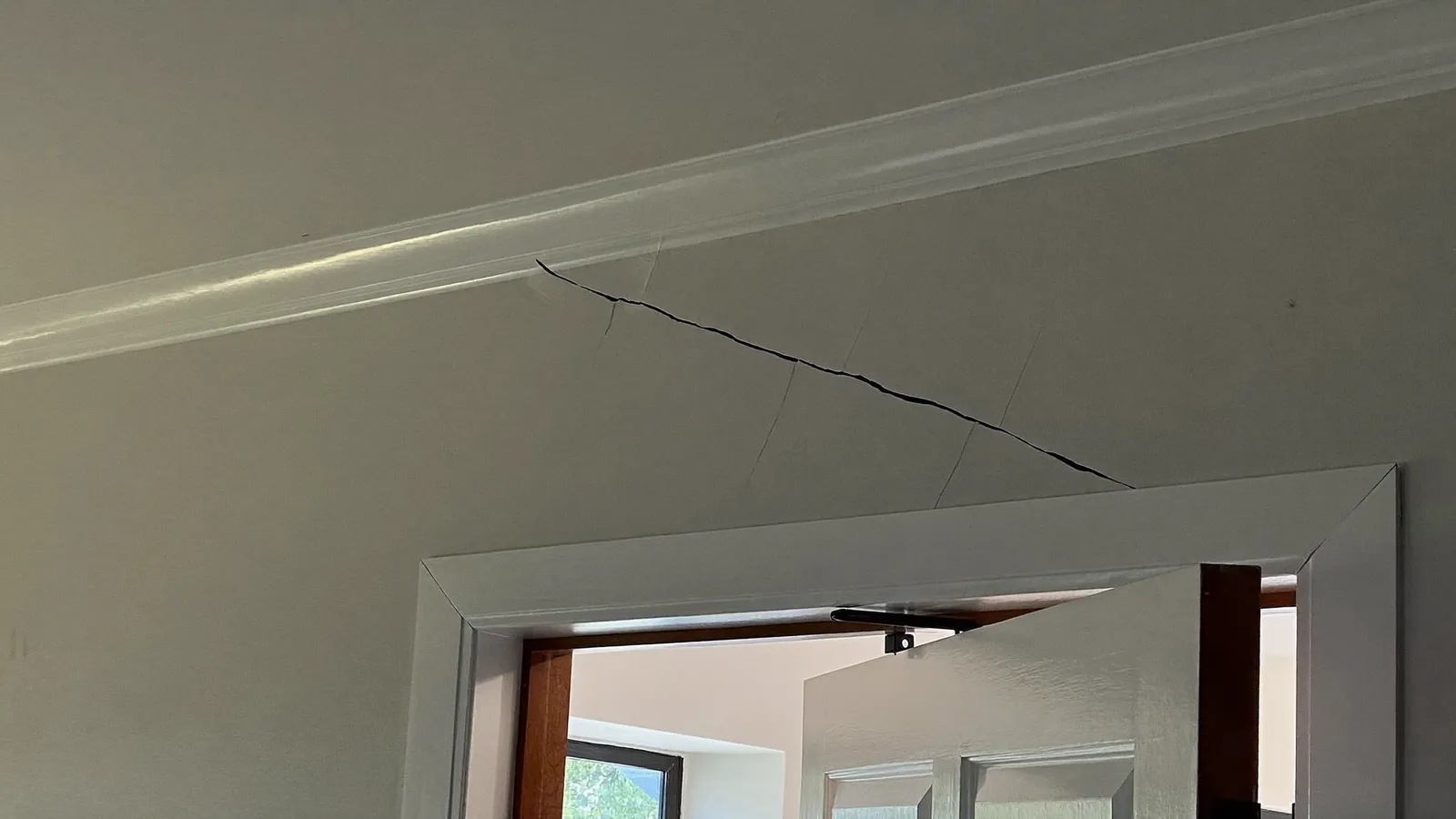
People usually call about a crack. Before you do, there is a useful sequence you can work through yourself, and it will either reassure you or give us far better information to start from.
What does not usually indicate a foundation problem
Fine cracks following a drywall joint. Tape lines move with humidity and seasonal change. Very common, rarely structural.
Hairline cracking in a slab or garage floor with no displacement. Concrete shrinks as it cures and nearly every slab develops some shrinkage cracking in its first year or two. If you can run a finger across and feel no step between the sides, and the floor reads level across it, it is almost certainly shrinkage.
Cracking in a house under two or three years old. New houses settle into their soil and materials shrink. Common, usually normal, and worth measuring rather than panicking about.
A single crack with nothing else. Foundation movement produces a pattern. One crack with no other symptom, in a house that otherwise behaves, is usually about the material rather than the ground.
What does warrant investigation
Stair-step cracking in brick veneer. Cracks climbing diagonally through the mortar joints are the classic indicator of differential movement, and the direction of the step points toward where the ground went.
Diagonal cracks from the corners of doors and windows. Openings are the weak point in a wall, so when a wall racks out of square the stress concentrates at the corners.
Cracks with vertical displacement. If one side of a crack sits proud of the other, something has moved out of plane. That is structural regardless of crack width.
Horizontal cracking in a below-grade wall. Rare here since basements are uncommon, but it indicates lateral pressure and is the most serious pattern there is. Treat it as urgent.
Doors binding on one edge. A door catching at the top on the latch side, or dragging on one corner, means the opening is out of square.
Floors sloping consistently in one direction. Not a dip at one board, but a steady fall across a room or down a hallway.
Gaps opening at baseboards, trim or ceilings. The frame moving away from the finish.
A chimney separating from the house. Chimneys are heavy and often on their own footing, so they are frequently the first element to move visibly.
A sequence you can work through
1. Look for a pattern. Walk the whole house, inside and out, and note where every crack is and which way it runs. Isolated and random suggests materials; clustered on one elevation, all leaning the same way, suggests movement.
2. Try the doors and windows. All of them. Note which bind and where. Doors on one side of the house catching while the rest are fine is informative.
3. Roll a ball. Crude but genuinely useful. A marble or a golf ball on a hard floor will find a consistent fall. Note which direction, in which rooms.
4. Walk the outside. Where do the downspouts discharge? Does the ground fall away from the house or back toward it? Is there standing water after rain? Are sprinklers hitting the wall? Are there mature trees close in, and on which side? This is where the cause usually is.
5. Check for water inside. Damp or warm patches on the floor, an unexplained rise in the water bill, movement concentrated around kitchens or bathrooms — all point to a possible under-slab plumbing leak, which needs excluding before anyone discusses piers.
6. Measure and date it. Mark the ends of a crack in pencil, write the date, and photograph it with a ruler or a coin for scale. Do it again in three months. A crack that has not moved in a season is behaving very differently from one that has.
7. Then call. With that information, an inspection becomes much more productive — and you will be able to tell whether whoever turns up is actually reading your house or reciting a script.
Common questions
How wide does a crack have to be before it matters?
Width is a poor guide on its own and it misleads in both directions. A narrow crack with vertical displacement — one side proud of the other — matters more than a wider crack with no displacement at all. As a rough indication, cracking beyond about a quarter of an inch is worth investigating, but the better questions are whether it has displacement, whether it is part of a pattern with other symptoms, and whether it is changing over time. Mark it, date it, photograph it.
My doors stick in summer but not winter. Foundation?
Possibly, and possibly just humidity. Timber doors swell in humid conditions and shrink in dry ones, so seasonal sticking is extremely common and often means nothing. The distinguishing signs are a door that binds in one specific corner rather than along a whole edge, a visibly uneven gap around the door when closed, accompanying cracking above the frame, and the pattern affecting doors on only one side of the house. Clay movement is also seasonal, so timing alone does not separate the two — the pattern does.
Is a cracked garage floor a problem?
Usually not. Garage slabs are often poured separately from the house slab, are thinner, carry vehicle loads and are exposed to greater temperature swings, so they crack readily. Shrinkage cracking with no displacement is normal and essentially cosmetic. What is worth a closer look is a garage floor crack with a step between the sides, or one that coincides with cracking in the garage walls or a door that no longer closes square.
What about cracks above my windows?
Worth paying attention to. Openings are the weakest points in a wall, so when a wall moves the stress concentrates at window and door corners — which makes a diagonal crack running up and away from a corner one of the more reliable indicators of racking. A horizontal crack directly above a window may instead relate to the lintel, which is a different repair. Either way, note which side of the house it is on and whether it appears at several openings.
Should I wait and see or act now?
Measure now, then wait, which gets you both. Mark and photograph the cracks with a date, take note of the doors and the floors, and look at the outside. Then have an elevation survey done to establish a baseline. Clay-driven movement here is frequently cyclical, and a crack that opens at the end of summer and closes after spring rain is telling you something you can only learn by observing across a season. The exceptions that warrant prompt attention are visible displacement, rapid change over weeks, or horizontal cracking in a below-grade wall.
Can I just fill the cracks myself?
For a fine shrinkage crack in a garage floor that collects dirt, yes, and it is a sensible bit of maintenance. For anything that is part of a pattern, filling it is counterproductive — not because it causes harm, but because it removes your evidence. A filled crack cannot be monitored, and whether it is moving is the single most useful thing you can find out. If you fill, photograph and date it first so you know what it looked like.
Related: Book an inspection · How the clay works · Crack repair · Foundation repair